
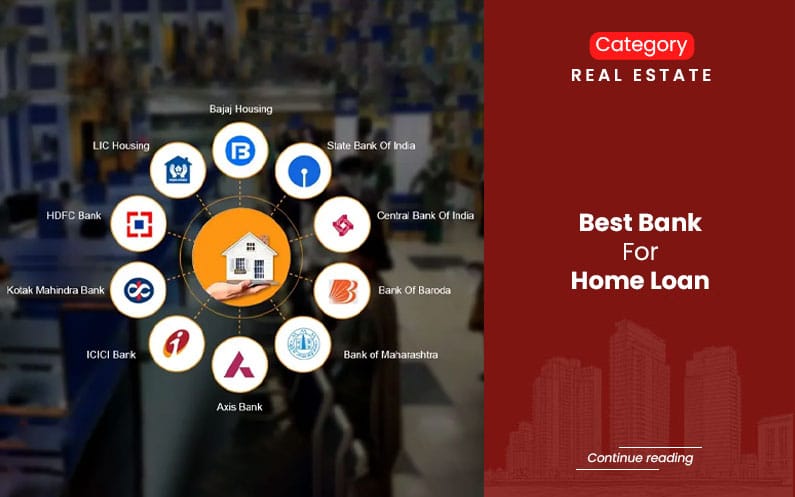
Choosing the best bank for a home loan can save an Indian homebuyer lakhs of rupees over a 15- to 30-year repayment period. But the right lender is not necessarily the bank advertising the lowest starting interest rate. In August 2026, rates vary considerably based on credit score, income, employment, and loan size. Buyers should compare interest rates, processing costs, repayment flexibility, service, and eligibility before making a decision.
What Makes the Best Bank for a Home Loan in 2026?
The housing finance market is highly competitive. Some public-sector banks are currently advertising home loans beginning around 7%, while large private-sector lenders offer their own combinations of pricing, faster digital processes, and relationship-based services.
This creates an interesting problem for borrowers.
A bank offering the lowest advertised rate may not provide you with its lowest rate. Risk-based pricing means that your credit score, income stability, profession, existing debts, loan amount, and other characteristics can influence the final quotation.
Therefore, identifying the best bank for a home loan requires comparing the actual offer available to you rather than choosing solely from advertisements.
A good home-loan comparison should consider interest rate, processing and administrative costs, benchmark structure, prepayment flexibility, maximum tenure, customer service, and the lender’s ability to process your particular property.
Best Bank for Home Loan: Compare the Total Cost, Not Just the Rate
Imagine Bank A offers you 7.20% while Bank B offers 7.35%.
Bank A initially seems like the obvious winner.
But what if Bank A has substantially higher upfront charges or its loan structure is unsuitable for your requirements? What if Bank B provides a better overdraft facility that allows you to reduce interest by keeping surplus funds against the loan?
The best bank for a home loan should therefore be selected according to your total borrowing requirements.
For most buyers, interest will remain the highest cost. But once competing lenders quote similar rates, fees, convenience and flexibility can become deciding factors.
Top 10 Banks for Home Loans in India: 2026 Comparison
The following top 10 banks for home loans in India provide a useful starting shortlist. This is not a ranking from universally “best” to “worst” because the final loan available to each borrower will differ.
Recent August 2026 market comparisons show several PSU banks clustered near the lowest end of current housing-loan rates.
| Bank | Indicative Starting Home Loan Rate* | Why Buyers May Consider It |
| Bank of Maharashtra | Around 7.00% | Very competitive headline pricing |
| Bank of India | Around 7.10% | Competitive PSU option |
| Union Bank of India | Around 7.15% | Large PSU branch network |
| Bank of Baroda | Around 7.20% | Competitive housing-loan range |
| Punjab National Bank | Around 7.25% | Major PSU lender |
| State Bank of India | Around 7.25% | Large network and established housing-loan business |
| Kotak Mahindra Bank | Around 7.60% | Private-bank alternative |
| HDFC Bank | Around 7.75% | Large housing-finance ecosystem |
| IDFC FIRST Bank | Around 7.75% | Private-sector alternative |
| Axis Bank | Around 8.00% | Major private-sector lender |
Indicative starting rates based on August 2026 market information. Rates can change, and the actual offer depends on borrower and loan characteristics.
This home loan bank list should be used to create a shortlist rather than automatically selecting the bank at the top.
1. State Bank of India: A Strong All-Round Contender
SBI naturally enters any discussion about the best bank for a home loan because of its scale, branch network, and established presence in housing finance.
Recent August 2026 comparisons place SBI’s starting housing-loan rate at approximately 7.25%, although the final applicable rate depends on the borrower’s profile.
SBI can be particularly attractive to buyers who value a large physical branch network and prefer dealing with a major public-sector lender.
For someone purchasing a house outside a major metropolitan area, branch accessibility can be important. Home loans involve property documentation, legal verification, disbursement, and servicing over many years.
However, do not choose SBI solely because of its size.
Request a personalised rate and compare it with at least two or three competing lenders.
2. Bank of Maharashtra: Worth Checking for Low Rates
Bank of Maharashtra deserves attention from rate-sensitive borrowers.
Recent August 2026 comparisons place its housing-loan rates at approximately 7.00% at the lowest advertised end, making it one of the most competitive headline offers currently reported.
Does that automatically make it the best bank for a home loan?
No.
The lowest rate is available only when the applicant satisfies the relevant eligibility and pricing criteria. Branch accessibility, processing experience, and the final rate offered for your specific profile should also be evaluated.
Nevertheless, if your priority is securing the lowest possible borrowing cost, Bank of Maharashtra belongs on your comparison list.
3. Bank of India: Another Competitive PSU Option
Bank of India is another public-sector lender worth considering when looking for the best home loan in India.
Recent August 2026 comparisons indicate rates beginning around 7.10%, although actual pricing varies.
A borrower with a strong credit profile should obtain a personalised quotation rather than relying on the advertised minimum.
This principle applies throughout the market.
A bank with a 7.10% starting rate might offer one applicant 7.30% and another a materially higher rate. Your objective is not to identify India’s theoretical minimum rate but the lowest suitable rate actually available to you.
4. Bank of Baroda: A Major PSU Alternative
Bank of Baroda is another prominent name among top home loan banks.
Recent comparisons place its starting housing-loan pricing at approximately 7.20%, although rates vary according to borrower characteristics and lending terms.
It is worth comparing Bank of Baroda directly with SBI, PNB, Bank of India, and other PSU lenders if you have a strong credit profile.
A difference of even 0.10%–0.25% can become meaningful when applied to ₹40 lakh, ₹60 lakh,h or ₹1 crore for two decades.
This is why the best bank for a home loan cannot be selected casually.
5. Punjab National Bank: Another Bank to Shortlist
Punjab National Bank remains another significant public-sector option.
August 2026 comparisons indicate starting rates around 7.25%, with the applicable range extending higher depending on the loan and applicant.
PNB may therefore deserve consideration alongside other PSU lenders when evaluating the best bank for a housing loan.
Rather than applying simultaneously everywhere, borrowers can first compare published rates and eligibility conditions before seeking quotations from a smaller shortlist.
This reduces unnecessary applications while still creating sufficient competition to negotiate.
6. Union Bank of India: Competitive Starting Pricing
Union Bank of India also appears near the competitive end of recent housing-loan comparisons, with rates reported from around 7.15%.
That makes it another potential candidate for borrowers primarily concerned with interest cost.
However, the same warning applies: starting rates are not guaranteed rates.
When evaluating the best bank for a home loan, ask Union Bank and competing lenders for the final rate based on your credit score, loan requirement, and employment category.
The written quotation is more useful than a promotional banner.
7. HDFC Bank: A Major Private-Sector Home Loan Provider
HDFC Bank remains an important consideration for buyers searching for the best home loan provider in India.
Its official current home-loan information shows rates benchmarked to the policy repo rate. The published special housing-loan range currently starts at approximately 7.75% and can extend considerably higher depending on the applicant’s profile.
HDFC Bank explicitly notes that factors such as credit profile, income, loan amount, and employment category influence pricing.
Therefore, comparing HDFC with PSU lenders is not simply a question of 7.75% versus 7.20%.
An existing customer, high-income applicant, or borrower with a particular property and service requirement may still find the overall HDFC proposition attractive.
8. ICICI Bank: Useful for Digital and Existing-Bank Customers
ICICI Bank should also be considered by buyers evaluating major private-sector lenders.
Its current official page advertises pre-approved digital home loans starting at 7.50% for qualifying customers, while its broader rate card varies according to credit score, employment, and loan amount.
ICICI also publishes a processing fee of 0.5% of the loan amount plus applicable taxes for its standard offering.
This demonstrates why finding the best bank for a home loan requires careful reading.
The eye-catching 7.50% figure applies to a particular pre-approved digital proposition and should not automatically be treated as the standard rate every new applicant will receive.
Existing ICICI customers should check whether they have a pre-approved offer before comparing it with competing banks.
9. Kotak Mahindra Bank: Another Private-Sector Choice
Kotak Mahindra Bank appears in current market comparisons with housing-loan rates beginning at approximately 7.60%, subject to eligibility.
It may therefore be worth including when comparing best home loans from private banks.
Private-sector lenders can appeal to borrowers looking for efficient digital processes, relationship banking or specific service preferences.
Nevertheless, convenience should be assigned a financial value.
If one lender offers dramatically faster processing but charges you a materially higher rate over 20 years, calculate how much that convenience ultimately costs before deciding.
10. Axis Bank: Consider the Complete Offer
Axis Bank completes our core list of major banking options.
Recent August 2026 comparisons place its housing-loan rates at approximately 8.00%, although final pricing depends on borrower characteristics.
Axis may not currently advertise the lowest headline rate among this particular group, but that does not automatically remove it from consideration.
Banking relationships, customised offers and applicant-specific pricing can change the equation.
If you already have a strong relationship with Axis, request a personalised quotation before making a decision.
The best bank for a home loan is determined by the actual offer—not a generic ranking.
Which Bank Is Good for Home Loan for Salaried Buyers?
If you are asking which bank is good for a home loan as a salaried borrower, begin with lenders offering competitive rates for strong credit profiles.
Stable salaried employment can make underwriting relatively straightforward because income can generally be established using salary slips, bank statements, Form 16, and income-tax records.
A salaried borrower with a strong credit score should compare at least a few PSU and private-sector lenders.
For example, you might obtain quotations from SBI or another competitive PSU lender, HDFC Bank, and ICICI Bank.
Then compare them side by side.
The best bank for a home loan may become obvious only after each lender assesses your profile.
Which Bank Is Better for Self-Employed Buyers?
Self-employed applicants can require a different approach.
Banks typically examine income-tax returns, business financials, banking patterns, business continuity, and existing obligations before determining eligibility.
Some borrowers may find that a lender willing to understand their business cash flows sanctions a larger or more suitable loan even if another bank advertises a lower headline rate.
Therefore, self-employed buyers should not focus exclusively on the lowest home loan available in advertisements.
The best housing finance arrangement is one that accurately assesses sustainable income without forcing the borrower into an unaffordable EMI.
How Much Can Choosing the Right Bank Actually Save?
Consider a ₹50 lakh housing loan over 20 years.
| Interest Rate | Approx. EMI | Approx. Total Interest |
| 7.00% | ₹38,765 | ₹43.04 lakh |
| 7.25% | ₹39,519 | ₹44.85 lakh |
| 7.50% | ₹40,280 | ₹46.67 lakh |
| 8.00% | ₹41,822 | ₹50.37 lakh |
| 8.50% | ₹43,391 | ₹54.14 lakh |
| 9.00% | ₹44,986 | ₹57.97 lakh |
Illustrative calculations assume the rate remains unchanged for the entire 20-year tenure. Actual floating-rate loans can change.
The difference between 7.25% and 8.50% is approximately ₹3,872 per month.
Over 20 years, the difference in total interest in this illustration exceeds ₹9 lakh.
That explains why researching the best bank for a home loan is worth several days of comparison before committing to decades of repayment.
Which Home Loan Is Better in India: Fixed or Floating?
The question of which home loan is better in India also involves choosing the interest-rate structure.
Floating-rate loans change according to their applicable benchmark and reset mechanism. They can become cheaper when benchmark rates decline but can also become more expensive when rates rise.
Fixed-rate loans provide greater predictability for the fixed period but may carry different pricing.
Hybrid products combine both structures. Recent developments in 2026 have also highlighted hybrid products that fix the rate initially before switching to floating pricing.
When selecting the best bank for a home loan, ask whether the quoted rate is floating, fixed, or hybrid,d and how future resets work.
Comparing 7.5% floating with 8% fixed without understanding the structure is not an apples-to-apples comparison.
Does Your CIBIL Score Change Which Bank Is Best?
Absolutely.
Credit score can materially influence both eligibility and interest pricing. Current lender information explicitly identifies credit or bureau score as an important pricing factor.
Someone with a strong repayment record can potentially access more competitive offers and negotiate from a stronger position.
Before applying, check your credit report for inaccuracies. Pay outstanding credit-card bills on time, avoid unnecessary unsecured borrowing,g and keep overall debt manageable.
Improving your financial profile can change which lender becomes the best bank for a home loan for you.
Home Loan Bank List: What Should You Compare?
A useful home loan bank list should contain more than bank names.
Create your own comparison using actual quotations:
| Factor | Bank 1 | Bank 2 | Bank 3 |
| Final interest rate offered | ___ | ___ | ___ |
| Floating/fixed/hybrid | ___ | ___ | ___ |
| Benchmark | ___ | ___ | ___ |
| Processing charges | ___ | ___ | ___ |
| Other upfront charges | ___ | ___ | ___ |
| EMI | ___ | ___ | ___ |
| Maximum tenure | ___ | ___ | ___ |
| Prepayment flexibility | ___ | ___ | ___ |
| Digital servicing | ___ | ___ | ___ |
| Branch accessibility | ___ | ___ | ___ |
This gives you a much stronger basis for selecting the best bank for a home loan than simply comparing advertisements.
Should You Choose a Bank or Housing Finance Company?
Banks are not the only institutions providing housing finance.
Housing finance companies also compete for borrowers, and the best housing finance option may occasionally come from an HFC rather than a traditional bank.
Eligibility assessment, interest-rate structure, and service can differ.
This can be particularly relevant for applicants with income profiles that do not fit conventional salaried underwriting neatly.
However, borrowers should compare the effective cost and contractual terms carefully regardless of lender type.
The goal is not to borrow from a bank simply because it is a bank. The goal is to obtain a suitable, transparent, and affordable housing loan.
Never Choose a Home Loan Based Only on Processing Speed
Property transactions can create urgency.
A developer may request payment within a deadline, or a seller may want quick confirmation. Under pressure, borrowers sometimes accept the first bank that sanctions the loan.
That can become expensive.
A home loan may continue for two decades after the urgency surrounding the property purchase has disappeared.
Give yourself sufficient time to compare top home loan banks before the payment deadline.
A few additional days spent finding the best bank for a home loan can potentially save several lakhs over the lifetime of the loan.
Can You Change Banks Later?
Yes, eligible borrowers can explore a home-loan balance transfer when another lender offers materially better terms.
But transferring is not automatically profitable.
Consider the outstanding principal, remaining tenure, new interest rate, processing expenses, and other transfer-related costs.
If only a few years remain on the loan, the savings may be too small to justify the effort and charges.
Before transferring, also ask your existing lender whether it can reduce or reprice your current rate.
The existence of balance transfers should not be an excuse to choose carelessly initially. Finding the best bank for a home loan at the beginning remains preferable.
Final Verdict: Which Is the Best Bank for Home Loan in India?
There is no single best bank for a home loan for every Indian borrower.
As of August 2026, recent comparisons show some public-sector banks advertising rates around 7%–7.25% at the lowest end, making lenders such as Bank of Maharashtra, Bank of India, Union Bank, Bank of Baroda, SBI and PNB worth examining for rate-conscious borrowers.
Major private-sector lenders such as HDFC Bank and ICICI Bank should also be compared, particularly when service, digital processing, existing relationships, or personalised offers matter. Their official information confirms that final rates can vary substantially according to borrower profiles.
So, if you are wondering which bank is good for a home loan, do not search for one universal winner.
Shortlist three to five lenders. Obtain personalised quotations. Compare interest rates, processing fees, benchmark structures, tenure and flexibility. Calculate the total interest payable, not merely the first EMI.
A home is likely to be one of the largest purchases you ever make. Choosing the best bank for a home loan should receive the same careful comparison as choosing the property itself.
Interest rates and product conditions referenced here reflect information available in August 2026 and can change. Verify the latest applicable rate and charges directly with the lender before applying.
